
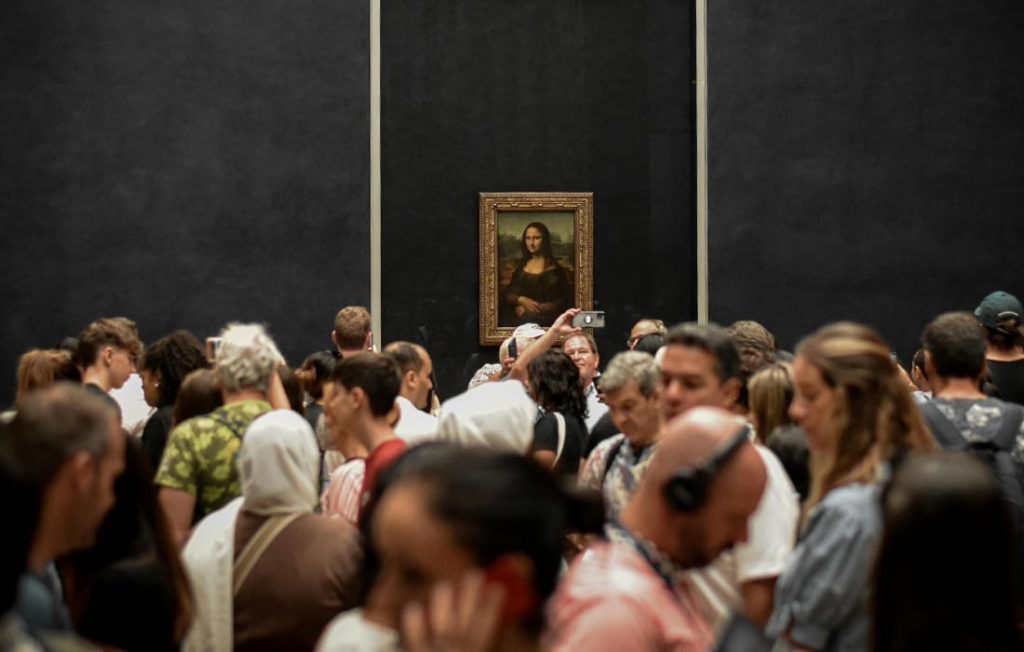
The Mona Lisa is one of the most famous and mysterious paintings in the world. The famous portrait painted by Leonardo da Vinci is still hiding secrets almost 500 years after it was created. Today it hangs, under tight security, in Room 6 of the Louvre Museum in Paris, and millions of people visit it every year.
Its fame comes from its artistic quality and from the many mysteries that surround it, starting with its name.
What is its real name?
The name “Mona Lisa” is a contraction of “Madonna Lisa”, which in old Italian means “My Lady Lisa”. Its real name in Italian is La Gioconda (La Joconde in French), a reference to Lisa Gherardini, the woman believed to have sat for the portrait, whose husband, Francesco del Giocondo, commissioned the work from Leonardo da Vinci.
However, other theories suggest she could be Da Vinci’s mother, Caterina Buti del Vacca, or a friend of Giuliano de’ Medici. Others believe the model may have been one of the artist’s lovers (a young man dressed as a woman) or even a self-portrait of Leonardo with feminine features.
What mysteries does the Mona Lisa hold?
- The enigmatic smile: The Mona Lisa‘s smile is one of its most intriguing features. It is a subtle, enigmatic smile that seems to change depending on the angle you look at it from. This optical illusion, known as “the elusive smile”, has been a source of fascination and study for centuries.
The smile of the Gioconda has been interpreted in many ways, from an expression of happiness to a gesture of melancholy or even indifference. Sometimes she seems to be smiling; at other times she looks more serious. This effect comes from the sfumato technique Leonardo used to soften outlines and create smooth transitions. - The eyes that follow you: Her gaze seems to follow whoever is looking at her, no matter the angle. This is due to the perspective and to the way Leonardo applied light and shadow.
Have you noticed that the Mona Lisa has no eyebrows or eyelashes? This is another of her mysteries. Nobody knows whether the artist left them out on purpose or whether they faded over time.
An Italian researcher, Silvano Vinceti, claimed that Da Vinci painted tiny numbers and letters in the Mona Lisa‘s pupils. The letters “LV”, possibly Leonardo da Vinci’s initials, appear in the right eye, while the left eye shows symbols that are hard to identify and could be “CE” or “B”. - The sfumato technique: Leonardo da Vinci used innovative techniques, such as sfumato and a balanced composition, which influenced Renaissance art and generations of later artists. With sfumato he created a soft, blurred effect and a sense of depth that earned him praise from the artists of his time.
- The 1911 theft: The theft took place on August 21, 1911, a Monday when the Louvre Museum was closed. The thief, Vincenzo Peruggia, an Italian handyman who had worked at the museum, used his knowledge of the building to walk off with the painting without raising suspicion.
The Mona Lisa stayed hidden for two years in Peruggia‘s apartment in Paris. In 1913, he tried to sell it to an art dealer in Florence, who alerted the authorities. Peruggia claimed his motive was patriotic, believing the Mona Lisa should return to Italy, its country of origin.

There are many imitations, replicas and versions of Da Vinci’s painting. The oldest and best preserved is the so-called “Mona Lisa’s twin”, which was made at the same time and with the same technique as the original.
Some of the places where you can see replicas of the Mona Lisa are:
Château de Chenonceau (France): The Château de Chenonceau, in the Loire Valley, France, displays a replica of the Mona Lisa believed to date from the 18th century. This version stands out for its ornate gilded frame and its prominent place in the château.
Prado Museum (Madrid): The Prado holds one of the oldest and best-known copies of the Mona Lisa, probably painted by one of Leonardo da Vinci’s pupils in the 16th century. This version, known as the “Prado Mona Lisa”, has some subtle differences from the original, such as a slightly different background landscape and a more youthful-looking model.
National Gallery of Art (Washington D.C.): The American art gallery has a replica of the Mona Lisa believed to have been painted in the 17th century. Although the author of this copy is unknown, it has been suggested that it may have been made by a Flemish or Dutch artist.
Philadelphia Museum of Art (Philadelphia): This museum holds a version of the Mona Lisa with a dark background and more dramatic lighting than the original. The exact date this copy was made and the identity of its author are unknown.

Center: the Mona Lisa painted in Leonardo’s workshop by one of his pupils, before restoration.
Right: the same painting after restoration, on display at the Prado Museum in Madrid
Besides these museums, other institutions and art galleries also display replicas of the Mona Lisa in their collections. Copies of this work are also common in temporary exhibitions and art-related events.
It’s important to remember that these replicas, although they may look similar to the original Mona Lisa, do not have the same artistic and historical value. Even so, their existence shows the lasting impact of this masterpiece on the art world and the fascination it continues to hold for the public.