



Artificial Intelligence (AI) is a technology that allows computers to learn from data, recognize patterns and perform tasks such as answering questions, translating, creating images or recommending music. It does not “think” like a person: it learns patterns from enormous amounts of information and uses them to generate answers.
How Does Artificial Intelligence Work?
If you have ever asked your phone to play a song, used Google Translate, or chatted with an AI assistant, you have already used Artificial Intelligence. Sometimes it feels almost magical: you type a question and, within seconds, an answer appears.
But behind that “magic” there is no human brain inside a computer. There are mathematics, data, and programs trained to detect patterns. AI does not understand the world the way we do; it learns from examples and uses them to make predictions.
Quick answer
Artificial Intelligence works because it receives large amounts of data, finds patterns in that data, and uses those patterns to make predictions or create new content. For example, if it has seen millions of cat photos, it can recognize a cat in a new image. If it has analyzed huge amounts of text, it can write sentences that sound natural. It is not conscious and does not have its own opinions; it is a powerful tool for processing information.
Where Should You Start?
The easiest way to start is to use AI as a helper for everyday tasks. You do not need to know how to code or understand everything happening behind the scenes.
Start by asking for something specific, for example:
- “Explain photosynthesis to me as if I were 10 years old.”
- “Create a one-month study plan to learn English.”
- “Translate this message into English.”
- “Give me ideas for a chicken dinner.”
- “Summarize this text in five bullet points.”
- “Create an image of an astronaut cat.”
The key is to be clear. The better you explain what you want, why you need it, and what format you expect, the better the result will be. Instead of saying “write me a text,” try: “Write a short, simple, and fun article about how AI works, with examples for beginners.”
What Does “Training” an AI Mean?
Imagine you want to teach a computer to recognize dogs. You do not simply tell it: “A dog has four legs, ears, and a tail,” because some dogs have no tail or their ears look different.
Instead, you show it thousands or millions of labeled photos: “this is a dog,” “this is a cat,” “this is a car.” Gradually, the system detects common features: shapes, colors, textures, and relationships between parts of the image.
That is training. AI learns from examples rather than from rules written one by one. Later, when you show it a new photo, it compares what it sees with the patterns it already knows and decides whether it is probably a dog.
Machine Learning: AI That Learns
Machine learning is a part of AI. It involves creating programs that can learn patterns from data without a person having to program every possible decision.
For example, a music app can observe which songs you listen to, which ones you repeat, and which ones you skip. Using that information, it tries to predict which other songs you may like. It does not know whether you are sad, happy, or exercising; it simply detects patterns in your choices.
Email spam filters work in a similar way. They learn to distinguish normal messages from suspicious ones by analyzing millions of examples. When a new email arrives, they calculate the probability that it is spam.
Neural Networks and Deep Learning
Inside machine learning, there is deep learning. It uses artificial neural networks, systems loosely inspired by the way neurons connect in the brain.
They are not biological neurons and do not copy the human brain exactly. They are layers of mathematical calculations that process information step by step. Each layer detects something different: in a photo, one layer may recognize edges; another, shapes; another, eyes or noses; and another may finally recognize a complete face.
The deeper the network—that is, the more layers it has—the more complex the patterns it can detect. That is why deep learning powers many modern AI systems, including speech recognition, translation, self-driving cars, and image or text generation.
How Does a Chatbot Respond?
When you type “How does AI work?”, a chatbot does not search for one answer stored in a folder. It analyzes your question, turns it into numbers, and calculates—word by word—which continuation is most likely based on everything it learned during training.
It is a bit like guessing the next word. If you read, “The cat climbed onto the…,” you probably think of “tree,” “sofa,” or “roof.” A language AI does something similar, but with an enormous amount of text and much more complex patterns.
That is why it can write emails, explain concepts, summarize articles, or hold a conversation. But it can also make mistakes, invent information, or mix up facts. Always check important information, especially dates, figures, news, health, money, or legal topics.
Generative AI: Creating Text, Images, and Music
Generative AI creates new content: text, images, music, audio, or video. It learns patterns from human-created content and then uses those patterns to produce something that did not exist exactly before.
For example, if you ask for “a fox reading a book in the rain,” it does not copy one specific image. It combines what it learned about foxes, books, rain, light, colors, and composition to generate a new image.
That explains why it can create surprising things, but also why it sometimes makes mistakes: it may draw strange hands, unreadable text, or impossible animals. It is creating a likely version, not a real photograph.
Can You Use It for Free?
Yes. Many AI tools have free versions, although they usually have limits.
You can use AI for free to:
- Chat and ask questions.
- Write and correct texts.
- Translate languages.
- Summarize articles or documents.
- Create simple images.
- Help you study or organize tasks.
- Generate ideas for trips, gifts, recipes, or projects.
Some platforms offer paid plans with more features, faster responses, higher usage limits, or more advanced models. But you do not need to pay anything to start: use a free tool, try different prompts, and learn how to write better requests.
Still, always check the privacy policy. Do not share passwords, bank details, private documents, or sensitive personal information with an AI.
What Can You Use It For?
AI can help you in many areas of daily life:
- Studying: explaining difficult topics, making summaries, or creating practice questions.
- Work: drafting emails, preparing presentations, organizing ideas, or analyzing information.
- Creating: writing stories, designing images, making music, or editing videos.
- Travel: planning routes, comparing options, or translating phrases.
- Home: suggesting recipes with the ingredients you have or helping organize tasks.
- Accessibility: converting speech to text, describing images, or translating conversations.
AI does not replace human judgment. It is a tool: it can save you time and give you ideas, but the final decision, fact-checking, and responsibility remain yours.
Does AI Think Like a Person?
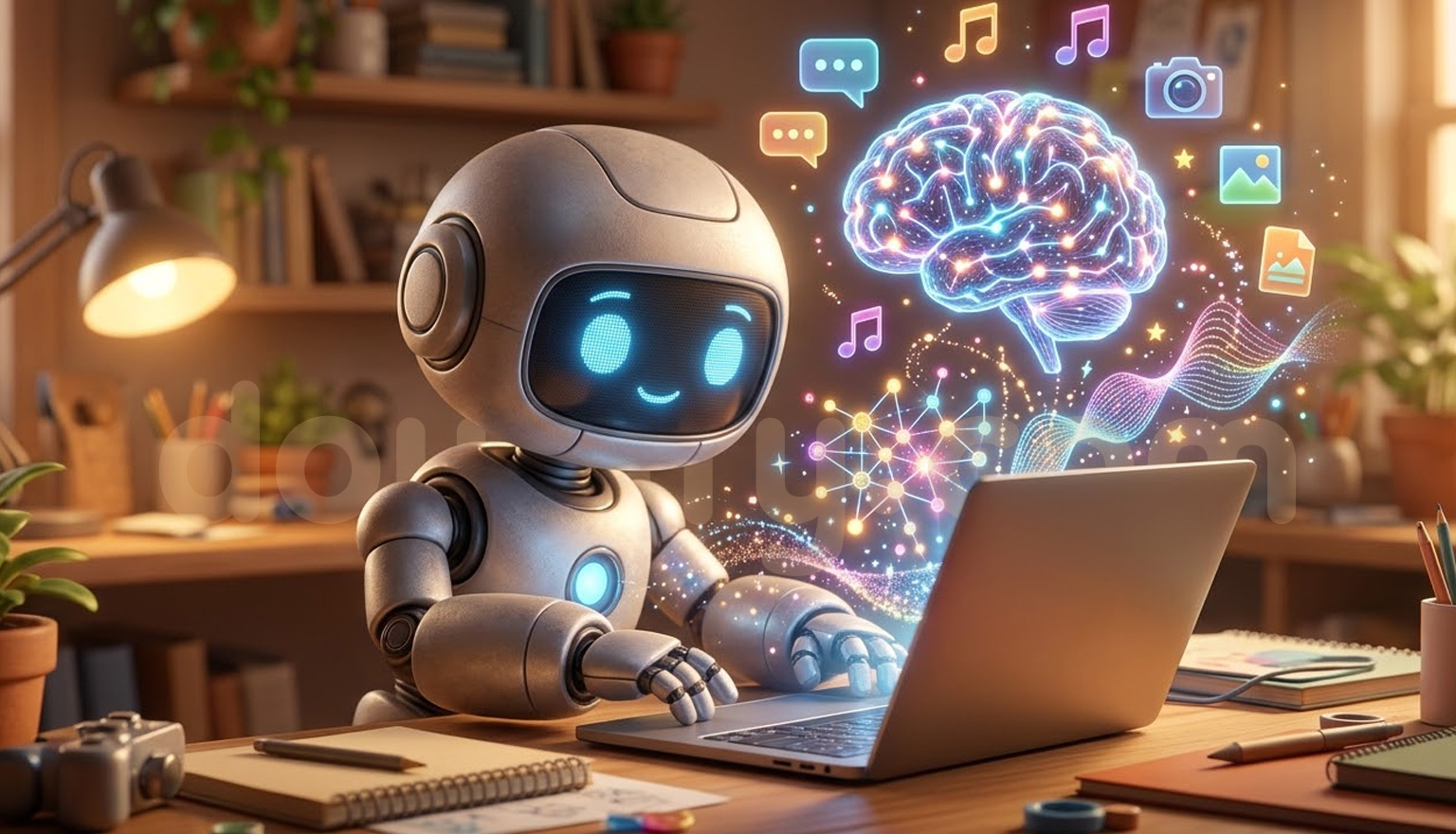
No. Even though it speaks naturally, it has no emotions, consciousness, or personal experiences. Google explains that generative AI is not a human being: it cannot think for itself or feel emotions; it is simply very good at finding patterns.
It may seem to “understand” because it responds coherently, but it performs calculations based on learned patterns. That is why it can sound confident even when it is wrong. Using it with curiosity—but also with critical thinking—is the best way to benefit from it.
A Fast-Changing World
AI is already present in phones, cars, hospitals, shops, social media, and translation systems. And it will keep evolving. The question is no longer only whether we will use it, but how we can learn to use it well.
The best way to start is simple: open an AI tool, ask it a useful question, and see what it answers. Then improve your prompt, ask for examples, request alternatives, and verify the information. That way, you will stop seeing it as something mysterious and start using it as a practical assistant.
Would you dare to ask an AI to help you with something today?


