


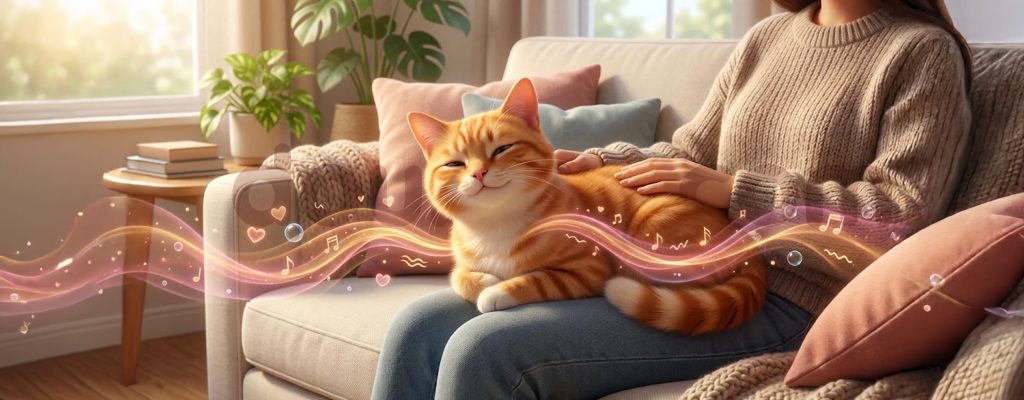
Cats purr mainly to communicate: it does not always mean they are happy. Purring can express calm and affection, but it also appears when a cat is nervous, ill, in pain or asking for something.
Why Do Cats Purr?
If you have ever petted a cat while it curled up beside you, you have probably heard that soft, vibrating sound that seems to say, “I’m fine.” For a long time, people believed purring simply meant happiness.
But the truth is more interesting. Cats also purr when they are stressed, at the vet, recovering from an injury, or even just before giving birth. That is why scientists believe purring has several meanings and functions, not just one.
Quick answer
Cats purr because it is a form of communication and, possibly, a way to calm themselves. The sound is produced in the larynx, the part of the throat that contains the vocal folds. As the cat breathes, structures in its larynx vibrate rapidly and create that continuous rumbling sound.
Where Should You Start?
The easiest way to understand it is to think of purring as a feline “language”. It does not translate exactly into a human word, but it does communicate information about how the cat feels and what it needs.
A cat may purr to say, for example:
- “I am calm and I like being with you.”
- “Please keep petting me.”
- “I feel insecure and need comfort.”
- “I am in pain and trying to relax.”
- “I am hungry” or “I want attention.”
To interpret it properly, do not rely on the sound alone. Watch the rest of the body: if the cat is relaxed, with half-closed eyes and a soft body, it is probably content. If it is hiding, tense, with its ears flattened back, or avoiding contact, purring may be a sign of discomfort.
How Is Purring Produced?
Purring begins in the larynx, also called the voice box. It is located in the throat and contains the vocal folds, structures that vibrate when air passes from the lungs.
For a long time, scientists believed the brain sent signals to the laryngeal muscles, making them contract and relax about 25 or 30 times per second. That movement would open and close the glottis—the space between the vocal folds—and create the characteristic sound.
However, research published in Current Biology in 2023 found something surprising: cat larynxes could produce purring-like vibrations even without nerve signals or muscle contractions. This suggests that airflow alone can make the vocal folds vibrate, as happens with many other animal sounds.
In other words, purring is not just “a muscle moving.” It is a combination of airflow, special throat anatomy, and probably brain control that decides when to start and stop.
Why Does It Sound So Low?
A cat’s purr usually falls between about 20 and 150 hertz (Hz). It is a low-frequency sound, similar to a deep rumble, which is why you can often feel it if you place your hand on the cat’s body.
Domestic cats have special structures inside their vocal folds: fatty “pads” that help them vibrate at such low frequencies. This anatomy allows them to produce a continuous, soft, repetitive sound without opening their mouth very wide.
That is why a cat can purr with its mouth closed, while sleeping beside you, or while eating calmly. It is almost as if it had a tiny vibration engine built into its throat.
It Does Not Always Mean Happiness
Here is one of the most important ideas: a purring cat is not always a happy cat. Purring can be a way to seek comfort when the animal feels vulnerable.
For example, a cat may purr at the veterinary clinic because it is scared. It may also purr after a fall, when it is in pain, or when it is ill. In those situations, purring could help it calm down, a little like a person taking slow breaths to manage anxiety.
So, if your cat is purring but also hiding, not eating, acting lethargic, or avoiding touch, do not assume everything is fine. Purring is a clue, not a diagnosis. If the behavior lasts a long time or you notice other symptoms, it is best to consult a veterinarian.
Can It Help Healing?
There is a popular theory that the vibrations of purring help repair bones and tissues. Some researchers have proposed that the low frequencies of a purr could support recovery, because certain frequencies are used in vibration therapies for humans.
But we should be careful. The fact that a frequency may have effects in human treatments does not prove that purring heals cats. The idea is interesting and could explain why cats purr when injured or stressed, but there is still no definitive proof that it is a healing mechanism.
What we do know is that purring seems to have a communication and calming function. It may help a kitten feel safer and strengthen the bond with its mother, other cats, or people.
A Sound That Starts in Kittens
Kittens purr from a very young age. When they are with their mother, purring may communicate that they are well, eating, or need attention. The mother may also purr to reassure them.
Later, the adult cat keeps this behavior and uses it in many situations. That is why, when a cat purrs on your lap, it may be saying something very simple: “I feel safe with you.”
There is also a type of purr known as a solicitation purr. Some cats combine it with a high-pitched meow when they want food or attention. It is a more insistent sound, designed to get a human’s attention.
Can You Use Purring to Understand Your Cat?
Yes, but as one signal among many, not as an absolute rule. Look at the whole picture:
- Purring with a relaxed body, half-closed eyes, and kneading paws: usually indicates well-being.
- Purring while seeking petting or rubbing against you: often affection and a request for attention.
- Purring in a new or stressful situation: may be self-soothing.
- Purring with pain, loss of appetite, hiding, or behavior changes: deserves veterinary attention.
The best way to “use” purring is to pay attention to context. A cat does not speak, but it communicates a lot through posture, ears, tail, eyes, and, of course, sounds.
A Mystery with Paws
Purring remains one of the most recognizable animal sounds, but it still holds secrets. We know broadly how it is produced and that it has several uses. What is still not entirely clear is why it evolved and how much it helps cats recover.
The next time your cat purrs, do not think only, “It is happy.” Think, “It is communicating.” It may be telling you that it feels comfortable, that it needs calm, or simply that it wants you to keep petting it.
Does your cat purr when it is with you, or also at strange moments?
🎨 How about drawing your own purring cat?
Grab your colored pencils and bring a kitty to life: at Coloringcolorea you will find lots of free cat coloring pages to print and color. Sleepy kittens, playful cats, cats with bows… you are sure to find one that purrs with joy!






owwwww ! I love cats !!