

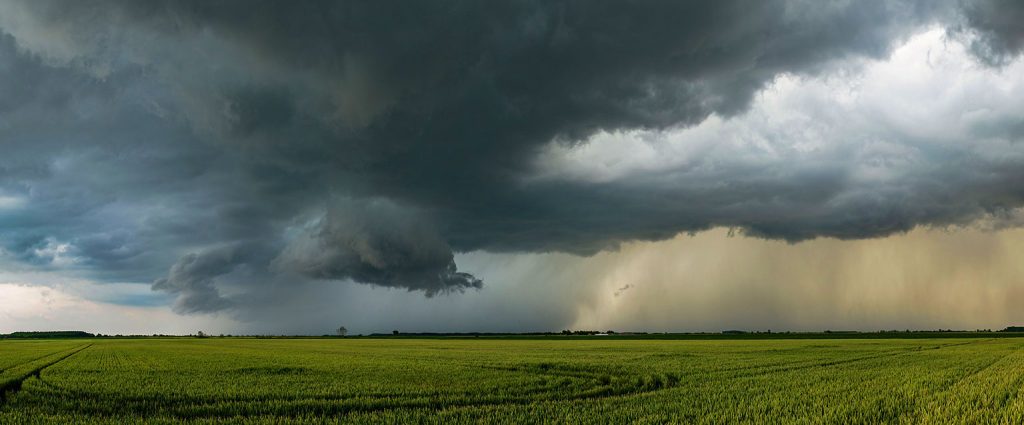
You have probably seen it a thousand times: on a sunny day, the sky fills with white, fluffy, peaceful clouds. Then, suddenly, huge gray clouds appear, as if they are announcing rain, thunder, or even a storm.
Why do some clouds look like white cotton, while others look so dark that they seem ready to swallow the sky? The answer lies in sunlight… and in the thickness of the clouds.
Quick answer
Summer clouds are usually white because they are small, light, and let a lot of sunlight pass through. Storm clouds are dark because they are much thicker and denser: they contain a huge amount of water and block or absorb sunlight before it reaches our eyes. They are not “black” inside; we are simply seeing their shadow.
White clouds reflect sunlight
Clouds are made of billions of tiny water droplets. When sunlight enters a cloud, it hits those droplets and scatters in every direction.
Because sunlight is white —a mixture of all colors— the droplets return all the colors equally. The result is a cloud that looks white. This happens through a phenomenon called Mie scattering: water droplets scatter all wavelengths of light in a similar way (NOAA).
Summer clouds, often called cumulus clouds, are those round, cotton-like clouds. They are usually relatively thin and full of light, which is why their tops shine with intense white (Met Office).
Storm clouds are gigantic
Storm clouds, especially cumulonimbus clouds, are another story. They can grow several kilometers upward and hold enormous amounts of water, ice, and raindrops.
When a cloud is that thick, sunlight has to pass through many layers of droplets. Much of that light is reflected upward, scattered, or blocked. That is why the bottom of the cloud —the part we see from the ground— looks gray, bluish gray, or almost black.
It is like looking at a cloud from underneath a giant umbrella: there may be plenty of light above, but below, everything is dim.
They are not black inside
Here is the trick: a storm cloud is not made of “dark matter” and it does not contain ink. In fact, even a cloud that looks impossible to see through is mostly made of air.
What happens is that, from below, we receive very little light from it. If we could see it from an airplane or from space, its top might still be white and bright, while its base remains dark.
That is why, when a storm approaches, the sky seems to darken: sunlight has not disappeared; the clouds are blocking it.
Why do they mean rain?
Storm clouds are dark because they contain a lot of water. The more water they hold, the thicker the cloud becomes and the more sunlight it blocks.
When those droplets become too large and heavy to keep floating, they fall as rain. And if there are strong air currents, ice, and electricity inside the cloud, thunder and lightning can occur.
So the dark color is a clue: it does not always mean it will rain immediately, but it does mean the cloud is carrying a lot of water.
A sky that changes color
Summer clouds and storm clouds can be made of the same things: air, water droplets, and sometimes ice crystals. The difference is their size, thickness, and amount of water.
- White summer clouds: thin, light, and full of sunlight.
- Gray or dark storm clouds: enormous, dense, and loaded with water.
- Clouds at sunset: they can look orange, pink, or red because sunlight travels through more of the atmosphere before reaching them (NOAA).
Next time you see a dark cloud, remember that it is not a “bad” or black cloud: it is a cloud so large and full of water that it is casting a shadow over the whole sky.
Have you ever noticed how the color of the sky changes just before a storm?