




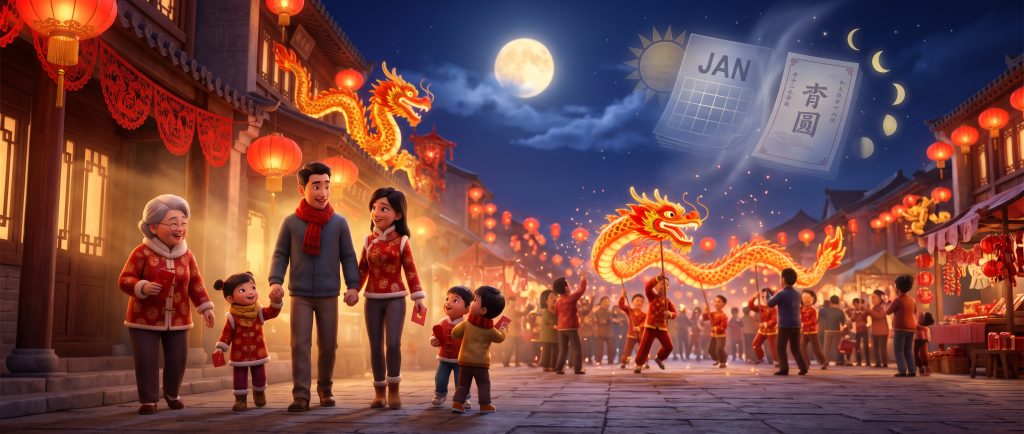
If you celebrate New Year on January 1st, it may seem strange that in China — and in many other Asian countries — the big celebration comes weeks or even months later. It is not a delay or a calendar mix-up: Chinese New Year follows a completely different calendar, based on both the Moon and the Sun.
The Short Answer
Chinese New Year does not start on January 1st because it follows a lunisolar calendar, based on the cycles of the Moon and the Sun. That is why its date changes every year and can fall between late January and mid-February. It is not a calendar mistake: it is a completely different way of measuring time.
A Lunisolar Calendar
The traditional Chinese calendar is lunisolar: it combines the movements of the Moon and the Sun. Months begin with the new moon, but the year is adjusted to stay aligned with the seasons.
That is why Chinese New Year does not fall on the same date every year in the Western calendar. It can begin anywhere from late January to mid-February, depending on when the second new moon after the winter solstice occurs.
The Moon Sets the Date
In the Western calendar, January 1st is a fixed date. In the Chinese calendar, however, the new year begins with the first new moon of the lunar year. That difference makes the date “move” every year.
For example, one year may start in late January, while the next begins in mid-February. China is not late — it simply follows a different celestial clock.
It Is Not Just a Party: It Is a Millennia-Old Tradition
Chinese New Year, also known as the Spring Festival, is one of the most important celebrations in Chinese culture. It marks the beginning of a new agricultural cycle and is full of symbols: family reunions, special meals, red decorations, money envelopes, and dragon and lion dances.
The date was not chosen at random: it is linked to the cycles of the Moon and the seasons, something essential for a civilization with a long agricultural tradition.
Famous Statues and Symbols
Although Chinese New Year is not directly linked to statues, Chinese culture is full of iconic monuments and figures that reflect its history and symbolism:
- The Terracotta Warriors (Xi’an, China): thousands of statues of soldiers that protected the first emperor, Qin Shi Huang, in the afterlife.
- The Leshan Giant Buddha (China): a massive statue carved into the rock that reflects the importance of Buddhism in the region.
- Stone lions (shishi): figures often found at the entrances of temples, homes, and official buildings, acting as symbolic protectors.
- The Chinese dragon: although not a statue itself, it appears in sculptures, temples, and decorations as a symbol of power, luck, and prosperity.
Did You Know?
Chinese New Year lasts 15 days, from the first new moon to the first full moon of the lunar year. The last day is celebrated as the Lantern Festival, with lights, parades, and, of course, lots of red lanterns.


